

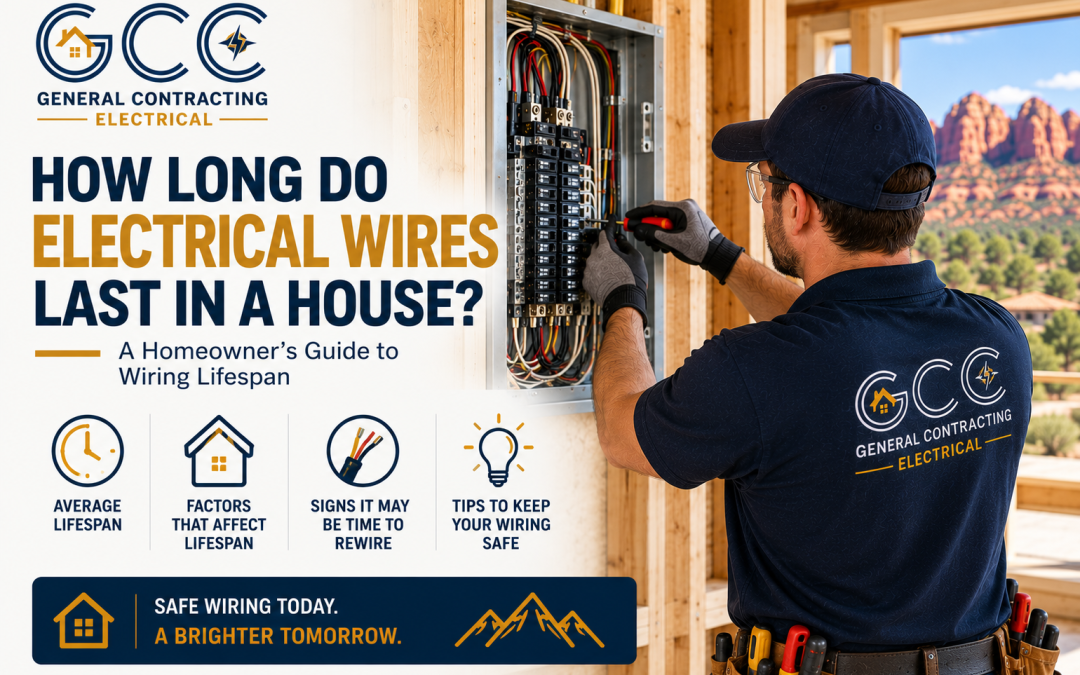
Modern copper house wiring often lasts 50 to 70 years or more, but the real answer depends on the wiring type, how hard it has worked, and the conditions around it. A licensed electrician in Sedona can read the age and condition of your wiring in a single visit, and homes with aluminum or knob-and-tube wiring, or no grounding, usually need attention sooner.
Introduction
Nobody thinks about wiring until something goes wrong, and that’s the problem. Unlike a roof or a water heater, the wires inside your walls give no obvious sign of age. They work fine right up until a connection overheats or the insulation crumbles.
So how long do electrical wires last in a house? There’s no single number, because “wiring” covers several generations of materials, from cloth-wrapped conductors in 1930s homes to the modern copper cable in newer builds. Heat, load, moisture, rodents, and past DIY work all change the timeline.
This guide covers typical lifespans by wiring type, what shortens them in Sedona and the Verde Valley, the difference between wiring repair, wiring replacement, and a full house rewire, and what an electrician checks when you call one in.
1. The Short Answer: Typical Wiring Lifespan by Type
Wiring lifespan depends mostly on the type installed. Modern copper cable commonly lasts 50 to 70 years or longer, while older cloth- or rubber-insulated wiring and knob-and-tube are generally past their useful life, and aluminum branch wiring is more about connection reliability than a fixed expiration date.
| Wiring Type | Typical Era | Commonly Cited Lifespan | Bottom Line |
|---|---|---|---|
| Modern copper cable (NM, “Romex”) | 1960s to present | 50 to 70+ years | Often fine if undisturbed and not overloaded |
| Early cloth- or rubber-insulated cable | 1920s to 1950s | Often 25 to 40 years for the insulation | Usually past its useful life |
| Knob-and-tube | Before roughly the 1940s to 1950s | Original insulation is typically well past its design life | Replacement generally recommended |
| Aluminum branch wiring | Roughly mid-1960s to mid-1970s | Conductor can last, but connections are the weak point | Needs specialist evaluation or remediation |
| Panel, breakers, outlets | Varies | Roughly 20 to 40 years, varying by component | Often need replacement before the wiring does |
These are commonly cited ranges, not guarantees. Conditions matter more than the calendar. A licensed electrician can tell you where your specific wiring stands after an on-site evaluation.
2. What Actually Determines How Long Wiring Lasts
Heat, electrical load, moisture, pests, and installation quality drive how fast wiring ages. Two homes built the same year can have very different wiring conditions, which is why age alone is a starting point, not a verdict.
The main factors:
- Heat. Insulation breaks down faster when it runs hot, whether from the environment (a hot attic) or from overloaded circuits.
- Electrical load. Wiring sized for a 1975 household may be running near its limit today with modern appliances, home offices, and EV chargers.
- Loose connections. Connections loosen over years of heating and cooling. Most wiring failures start at the connection, not along the wire.
- Moisture. Damp crawl spaces, roof leaks, and exterior boxes shorten life.
- Pests. Rodents chew insulation, exposing bare conductors.
- Past DIY or unpermitted work. Improper splices and mismatched components can fail long before the original wiring would.
3. Wiring Types and Their Real-World Lifespans
Each generation of wiring has its own failure pattern. Knowing which type is in your walls tells you far more than the number of years it has been there.
Modern Copper Cable (NM / “Romex”)
This is the standard in most homes built from the 1960s onward. Copper conductors with a plastic sheath and a ground wire commonly last 50 to 70 years or longer when they stay cool, dry, and within their load rating. Problems tend to come from overloaded circuits, damaged sheathing, or loose terminations rather than the copper itself.
Early Cloth- and Rubber-Insulated Wiring
Wiring from roughly the 1920s through the 1950s often used rubber insulation wrapped in cloth. Rubber dries, hardens, and cracks over decades. Once the insulation flakes off, bare conductors can contact framing or each other. If your home has this wiring, plan on replacement rather than repair.
Knob-and-Tube Wiring
Common in homes built before roughly the 1940s and 1950s, knob-and-tube runs individual conductors through ceramic knobs and tubes. It has no ground wire, and its insulation is now very old. It was also designed to shed heat into open air, so burying it in modern insulation creates a hazard. Many insurers restrict or decline coverage for it, so check your policy.
Aluminum Branch Wiring
Used in many homes from roughly the mid-1960s to the mid-1970s, aluminum expands and contracts more than copper, and connections at outlets and switches can loosen and overheat over time. The wire may not “expire” on a schedule, but the system is only as reliable as its connections. The U.S. Consumer Product Safety Commission has published guidance on aluminum wiring, and an electrician can recommend the right remediation.
Ungrounded (Two-Prong) Circuits
Not a wiring material, but an era marker. Two-prong outlets throughout a home usually mean the circuits have no ground conductor. Even if the wires are in good shape, the system lacks a safety feature modern electronics and appliances expect.
4. Other Parts of Your Electrical System Age Faster Than the Wires
In most homes, the panel, breakers, outlets, and switches wear out well before the wire inside the walls. These components have moving parts and contacts that degrade with use, so “my wiring is fine” often really means “my wiring hasn’t been checked.”
- Electrical panel: Panels are commonly cited as having a 25 to 40 year service life. Certain older brands, including Federal Pacific and Zinsco, have well-documented problems and are often replaced on sight.
- Circuit breakers: Breakers can weaken and fail to trip when they should.
- Outlets and switches: Worn contacts cause loose plugs, heat, and arcing. Heavily used outlets wear out first.
- GFCI and AFCI devices: These protective devices have a finite life and should be tested regularly.
If you’re asking about wiring lifespan because of a fuse box, a hot panel, or frequent breaker trips, you may need a panel upgrade rather than a full rewire.
5. Sedona and Northern Arizona Factors That Age Wiring
The Verde Valley’s climate and housing mix put specific stress on residential wiring. Attic heat, pests, monsoon moisture, and a good number of older and owner-modified homes all show up in local electrical work.
- Attic heat: Summer attic temperatures in the Verde Valley can run far above outdoor temperatures. Heat accelerates insulation aging, especially on attic runs and recessed lighting.
- Pack rats and rodents: Wildlife intrusion in attics, crawl spaces, and garages is a recurring cause of damaged wiring in desert foothill homes.
- Monsoon moisture: Roof leaks and wind-driven rain can reach junction boxes, attic wiring, and exterior fixtures.
- Older and character homes: Parts of Cottonwood, Clarkdale, Jerome, and older Sedona neighborhoods include homes with original or partially updated wiring. Ask when the panel and wiring were last updated.
- Elevation differences: In Flagstaff, long cold winters and heavy heating loads (and space heaters) are common stress points on older circuits.
- Additions and remodels: Homes that have been added onto over decades often have a patchwork of wiring generations that all need to work together.
Confirm with your electrician which of these factors apply to your specific home. Conditions vary house by house.
Read More:Complete Homeowner’s Guide to Residential Wiring
6. Signs Your Wiring Is Near the End of Its Life
Warning signs usually show up before a failure. Look for warm outlets, flickering lights, frequent breaker trips, burning smells, discolored plates, buzzing sounds, and a fuse box or two-prong outlets that mark an older system.
- Lights that flicker or dim when appliances start
- Outlets or switch plates that are warm, discolored, or crackling
- Breakers that trip often or won’t reset
- A burning or hot-plastic smell with no obvious source
- Frayed, brittle, or cracked insulation visible in an attic or panel
- A fuse box, or two-prong outlets throughout the house
For the full breakdown, see our guide to the 10 signs your home needs rewiring. A burning smell or hot panel is not a wait-and-see situation. Shut off the circuit if you can do so safely and call a licensed electrician the same day.
7. Electrical Wiring Repair vs. Replacement vs. House Rewiring
Not every aging-wiring problem means tearing out the whole house. The right scope depends on what’s failing: a single bad circuit calls for repair, a failing run or outdated section calls for replacement, and widespread outdated wiring points to a full rewire.
| Option | Best For | What It Involves |
|---|---|---|
| Electrical wiring repair | An isolated problem: one damaged cable, a bad connection, a failed outlet or switch | Locating and fixing the specific fault. Often one visit |
| Electrical wiring replacement | A circuit, room, or section with old or damaged wiring (for example a rodent-damaged attic run or a kitchen being remodeled) | Removing and replacing wiring for specific circuits |
| House rewiring (full rewire) | Knob-and-tube, cloth/rubber insulation, aluminum branch wiring, or widespread symptoms | Replacing branch wiring throughout the home, typically with a panel upgrade and grounding |
How electricians decide: The call usually comes down to the wiring type, its condition where the electrician can inspect it, how widespread the symptoms are, and what else you’re planning (a remodel or addition is the most cost-effective time to open walls).
Cost and timing: Both depend on the home’s size, age, wall access, and whether you live there during the work. There’s no honest flat number, so get a written estimate after an on-site walkthrough. If a full rewire is the answer, ask whether the work can be phased, and whether it can be coordinated with any planned remodel.
8. What to Expect When You Call an Electrician in Sedona
A licensed electrician in Sedona will usually start by identifying your wiring type and the age of your panel, then test and inspect outlets, connections, grounding, and visible wiring to judge condition and capacity. You should come away with findings in writing, not just a verbal opinion.
A typical evaluation covers:
- Panel check: Age, brand, condition, available capacity, signs of overheating.
- Wiring identification: Copper, aluminum, knob-and-tube, or a mix, from the panel, attic, or accessible outlets.
- Grounding and protection: Whether circuits are grounded and whether GFCI/AFCI protection is where it should be.
- Connection and outlet testing: Looking for loose connections, heat damage, and failed devices.
- Findings and options: A clear explanation of what’s urgent, what can wait, and whether repair, replacement, or a rewire fits.
Questions worth asking:
- What type of wiring do I have, and what year does it date to?
- Is anything an active safety hazard, or is it a “plan for it” item?
- Can you give me repair, partial replacement, and full rewire options with written estimates?
- Who pulls the permit, and will there be an inspection after the work?
For a deeper look at the licensing side, read our guide on certified vs. licensed electricians and why hiring a licensed electrical contractor in Arizona matters.
9. Choosing an Electrical Contractor in Sedona
When you’re comparing an electrical contractor in Sedona, verify the Arizona ROC license, ask about insurance, and look for local experience with older homes in the Verde Valley. An in-house team that also handles general contracting can coordinate wiring work with drywall, remodels, and additions so walls aren’t opened twice.
What to look for:
- An active Arizona Registrar of Contractors license you can verify yourself
- Liability insurance and workers’ compensation coverage
- Written estimates with the scope clearly described
- Permits pulled and inspections scheduled as part of the job
- Experience with older homes, panel upgrades, and rewiring in your specific town
General Contracting and Electrical Services LLC provides licensed residential electrical work, panel upgrades, and house rewiring across Sedona, Cottonwood, Camp Verde, Clarkdale, Jerome, Flagstaff, Prescott, and the surrounding area. See our Sedona home electrician services for the full scope.
Expert Tips
- Find out your wiring type before you remodel. Opening walls is the cheapest time to replace old wiring.
- Check the panel first. It’s the fastest indicator of how old the rest of the system is.
- Don’t cover knob-and-tube with insulation. It needs open air to shed heat.
- After any rodent problem, have attic and crawl space wiring inspected. Chewed insulation isn’t always visible.
- Keep records. Panel upgrades, rewiring, and permits are worth documenting for insurance and resale.
Common Mistakes Homeowners Make
- Judging wiring only by the home’s age. Conditions, load, and past work matter as much as the year.
- Replacing outlets and switches and assuming that fixes an aging system. New devices on old, damaged wire don’t solve the underlying problem.
- Using adapters on two-prong outlets. They fit the plug but don’t add grounding.
- Ignoring a fuse box or a warm panel because “it still works.”
- DIY wiring fixes. Improper splices and unpermitted work are a common source of failures, and may cause problems at sale or with insurance.
- Choosing the cheapest bid without comparing scope. A rewire estimate that skips grounding, a panel upgrade, or patching isn’t really cheaper.
Wiring Lifespan Quick Reference
| If your home has… | Likely meaning | Typical next step |
|---|---|---|
| Modern copper wiring, grounded outlets, newer panel | Wiring is probably within its service life | Routine inspection every 10 to 15 years |
| Fuse box or an older panel | System predates modern capacity and protection | Panel evaluation and likely upgrade |
| Cloth- or rubber-insulated wiring | Insulation is well past its design life | Plan a rewire |
| Knob-and-tube | Obsolete, ungrounded, heat-sensitive | Replacement generally recommended |
| Aluminum branch wiring (mid-1960s to mid-1970s) | Connection reliability concerns | Specialist evaluation and remediation |
| Two-prong outlets throughout | No grounding conductor | Grounding upgrade or rewire |
| Rodent or moisture damage | Localized damage | Repair or replacement of the affected runs |
Key Takeaways
- Modern copper house wiring commonly lasts 50 to 70 years or more, but conditions and workmanship can shorten that.
- Cloth/rubber-insulated wiring and knob-and-tube are generally past their useful life, and aluminum wiring needs specialist attention.
- Panels, breakers, and outlets usually age out before the wire does.
- Sedona’s attic heat, pests, and monsoon moisture can accelerate wear, and a fair number of local homes have older or patched wiring.
- Repair fixes an isolated fault, replacement handles a section, and a full rewire is for widespread or obsolete wiring.
- A licensed electrician’s on-site evaluation is the only reliable way to know where your wiring stands.
Frequently Asked Questions
1. How long do electrical wires last in a house?
Modern copper house wiring often lasts 50 to 70 years or more under normal conditions. Older cloth- or rubber-insulated wiring and knob-and-tube are generally beyond their useful life. Heat, overloads, moisture, and rodents can shorten any wiring’s lifespan, so an inspection tells you more than age alone.
2. At what age does a house need to be rewired?
There’s no fixed age. Homes with knob-and-tube, cloth-insulated, or aluminum branch wiring typically need rewiring or remediation, while homes with modern copper wiring may not for decades. Symptoms like warm outlets, flickering lights, and frequent breaker trips are better triggers than the calendar.
3. How much does house rewiring cost in Sedona?
It depends on the home’s size, age, wall access, wiring type, and whether you’re living there during the work. An electrician in Sedona can give an accurate written estimate after an on-site walkthrough, since prices vary widely by scope.
4. What’s the difference between electrical wiring repair and electrical wiring replacement?
Repair fixes a specific fault, such as one damaged cable or a bad connection. Replacement removes and replaces the wiring for a circuit, room, or section. A full house rewire replaces branch wiring throughout the home.
5. How do I know what type of wiring my house has?
Age is a clue, but the reliable way is an inspection. An electrician can identify copper, aluminum, or knob-and-tube from the panel, attic, or accessible outlets and boxes.
6. Is aluminum wiring dangerous?
It can be, mainly because connections at outlets and switches can loosen and overheat over time. Not every aluminum-wired home has a problem, but it deserves a professional evaluation and, often, remediation. The U.S. Consumer Product Safety Commission publishes guidance on it.
7. Do outlets and switches wear out?
Yes. Contacts loosen and degrade with use, which is why old outlets can run warm or hold plugs poorly. Replacing worn devices is routine maintenance, but if an outlet is hot or sparking, the wiring behind it needs inspection too.
8. Can I rewire my house in stages?
Often, yes. Many homeowners phase the work by area or circuit, especially if they live in the home. A licensed electrician can plan a sequence that keeps essential circuits working and coordinates with any remodel.
9. Do I need a permit and inspection for rewiring in Arizona?
Rewiring and panel work generally require a permit and inspection under local code, and the work should be done by a licensed electrical contractor. A licensed contractor usually handles permitting. Confirm requirements with your local building department.
10. How often should older wiring be inspected?
As a general guideline, homes 25 to 30 years old or more benefit from an electrical inspection every 10 to 15 years, and sooner if you see warning signs, buy a home, or plan a remodel.
11. What should I look for in an electrician in Sedona?
Check for an active Arizona ROC license, insurance, written estimates, permit handling, and experience with older homes in the Verde Valley. Ask for findings in writing so you can compare repair, replacement, and rewire options.
12. Does homeowners insurance care about old wiring?
Some insurers ask about wiring type and panel age, and may restrict or surcharge coverage for knob-and-tube or certain panel brands. Check with your carrier directly, since policies vary.
Conclusion
Wiring doesn’t come with an expiration label, but it does have a lifespan, and that lifespan depends on what’s in your walls and what it has lived through. Modern copper wiring can serve a house for generations. Cloth-insulated, knob-and-tube, and aluminum wiring are a different story, and Sedona’s heat, pests, and older housing stock add their own wear.
If you don’t know your wiring type or when your panel was last updated, the most useful next step is a conversation with a licensed electrician in Sedona who can inspect it and tell you plainly whether you need a repair, a replacement, or nothing at all.
Not sure how old your wiring is, or seeing warning signs? General Contracting and Electrical Services LLC provides licensed electrical inspections, wiring repair and replacement, panel upgrades, and house rewiring for Sedona, Cottonwood, Camp Verde, Flagstaff, Prescott, and the Verde Valley. Contact us to schedule an evaluation and get findings in writing.
Recent Comments