


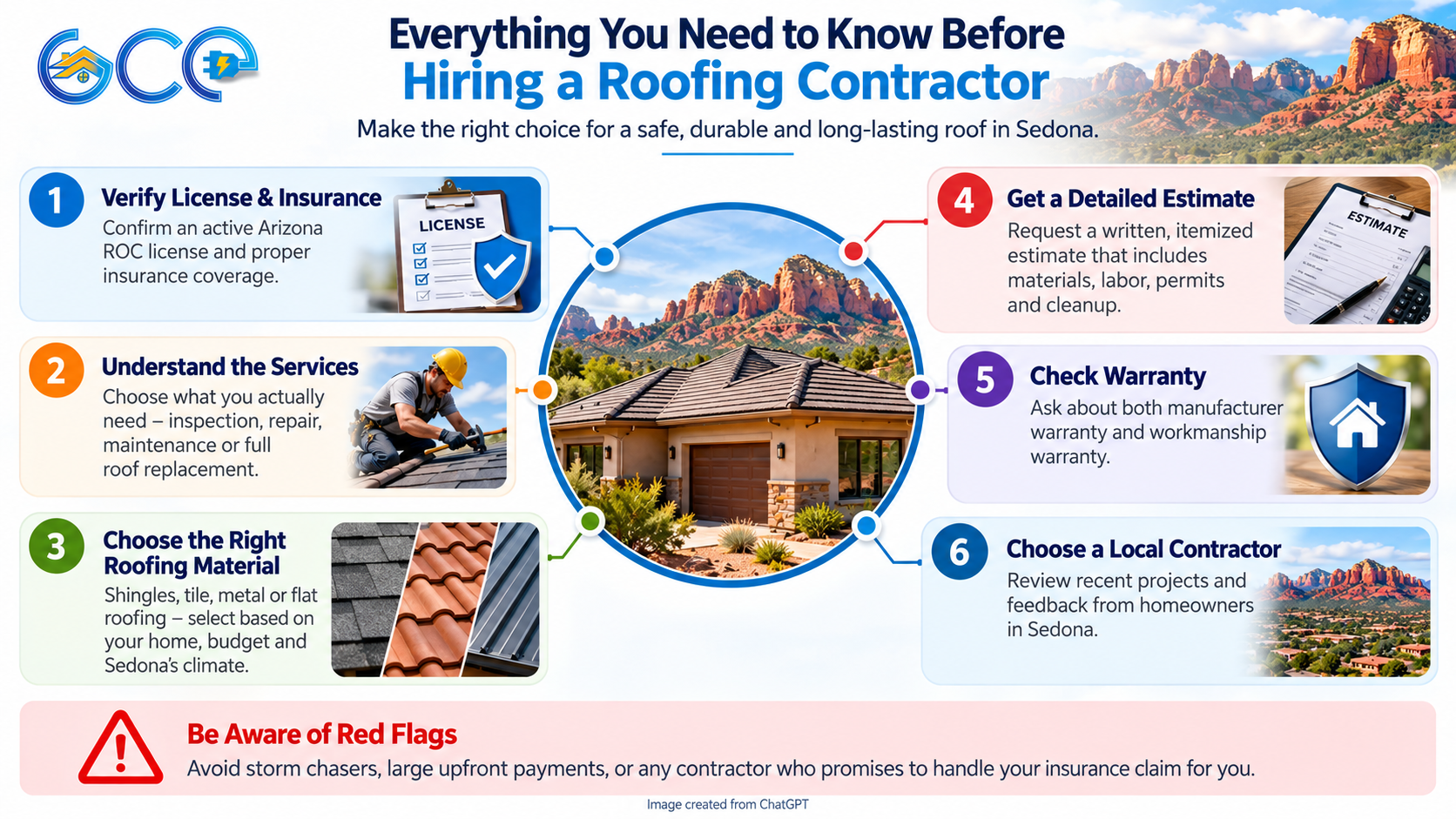
Before hiring a roofing contractor in Sedona, confirm an active Arizona ROC license and insurance, get an itemized written roof estimate, ask about materials and warranty, and check local references. Be cautious of storm chasers, large upfront payments, and any contractor who promises to handle your insurance claim for you.
Introduction
Hiring a roofing contractor is a high-stakes decision. The roof is one of the most expensive parts of your home, and mistakes tend to show up months later as leaks, stains, and damaged ceilings. In Sedona, the work also has to handle intense sun, monsoon storms, and wide temperature swings.
This guide covers what a roofing contractor does, the services you may need, how roofing materials compare for the Verde Valley, how to verify licensing, and how to read a roof estimate. It also explains what to do when you need emergency roof repair, how insurance-related repair support works, how roof replacement is scheduled, and what to ask before you sign. Commercial roofing is included for business owners.
1. What a Roofing Contractor Actually Does
A roofing contractor inspects, repairs, replaces, and maintains roofs, and manages the materials, labor, permits, and cleanup involved. For homeowners, residential roofing services cover shingle, tile, metal, and flat roofs, plus the details around them such as flashing, vents, and the roof edge.
A good roofing contractor also tells you when you don’t need a new roof. Honest assessments, written findings, and clear options (repair now, replace later, or replace now) are what separate a contractor from a salesperson. If you search “roofing companies near me,” you’ll see both kinds in the results.
Residential vs. commercial: A home roofing service typically deals with sloped roofs and local code, while commercial roofing involves large flat or low-slope systems, building owners, tenants, and maintenance plans. Not every roofer does both, so ask which applies to your property.
2. Roofing Services Explained
Most roofing needs fall into inspection, repair, maintenance, or replacement. Knowing which service you need helps you compare contractors on the same terms, and helps you spot a contractor who recommends a full replacement when a repair would do.
| Service | When You Need It | What to Ask |
|---|---|---|
| Roof inspection | Annually, after storms, before buying or selling | Will I get written findings and photos? |
| Roof leak repair | Stains, drips, damp attic insulation | Do you find the source, or just patch the stain? |
| Flashing repair | Leaks around chimneys, vents, skylights, and valleys | Will you replace or reseal the flashing? |
| Roof damage repair | Missing, cracked, or lifted material after wind or hail | Is the damage localized or widespread? |
| Fascia and soffit repair | Rotting, sagging, or pest-damaged roof edges | Will airflow through the soffit vents be preserved? |
| Roof ventilation improvements | Hot attic, uneven wear, high cooling costs | Is intake and exhaust airflow balanced? |
| Roof maintenance services | Routine upkeep to extend roof life | What does a maintenance visit include? |
| Roof replacement | End of life, widespread damage, repeated leaks | What’s included in tear-off, underlayment, and disposal? |
Why flashing matters: Flashing around roof penetrations is a common source of leaks, and it’s often overlooked when contractors only look at the shingles or tile. Ask whether flashing repair or replacement is included in any estimate.
Why ventilation matters: A roof that can’t breathe holds heat in the attic. Roof ventilation improvements can lower attic heat and help roofing materials last, though results depend on the house.
For a broader overview of roofing services, see our roofing services page.
3. Roofing Materials for Sedona and Northern Arizona
Material choice affects heat, durability, fire resistance, and cost. Shingle roofing is common and affordable, tile roofing suits Southwest architecture, metal roofing handles heat and monsoon rain well, and flat roofing is typical on low-slope and commercial buildings. The right choice depends on your roof, budget, and local conditions.
| Material | Strengths | Trade-Offs | Notes for Sedona |
|---|---|---|---|
| Shingle roofing (asphalt) | Lower upfront cost, widely available | Sun and heat can age shingles faster | Ask about ventilation and fire rating |
| Tile roofing Sedona | Durable, suits Southwest style | Heavy, and underlayment often wears out before tile | Ask whether tile will be lifted and reset during re-roofing |
| Metal roofing | Long lifespan, reflects heat, sheds rain | Higher upfront cost, installation quality matters | Popular for heat and fire resistance |
| Flat roofing | Common on low-slope homes and commercial buildings | Ponding water and drainage are the main risks | Drainage planning is critical during monsoon season |
Heat-resistant roofing: If you’re searching for “heat-resistant roofing near me,” ask about light-colored or reflective materials, proper ventilation, and whether the product is rated for high-temperature exposure. Results vary by product, so rely on manufacturer data.
Fire rating: Sedona and the Verde Valley are in wildfire country. Ask for the fire classification of any roofing assembly, not just the surface material.
Northern Arizona roofing services: Conditions differ across the region. Flagstaff adds snow load and freeze-thaw cycles, Sedona adds heat and monsoon rain, and Prescott sits in between. A roofer should know the demands of your specific town.
4. Licensing, Insurance, and Verification
Verify that any roofing contractor holds an active Arizona Registrar of Contractors license in a roofing classification, carries liability insurance, and has workers’ compensation coverage if they have employees. This takes minutes on the ROC website and screens out most unqualified operators.
What to verify:
- Active ROC license in the correct roofing classification (residential or commercial). Look it up at azroc.gov using the license number, and confirm the business name matches the contract.
- Liability insurance and workers’ compensation (ask for current certificates).
- Local address and history. A local roofing contractor is easier to reach if something goes wrong.
- Complaint history with the ROC and the Better Business Bureau.
A note on names: Words like “premier” and “best” in a company name or ad prove nothing. Searching “Premier roofing” returns many unrelated companies, so confirm the exact legal name and license number on the contract, not just the logo on the truck.
Recovery fund: The ROC administers a Residential Contractors’ Recovery Fund that may help homeowners in some cases when a licensed contractor’s work or conduct falls short. Eligibility rules apply, so ask the ROC. Working with a licensed contractor is generally a prerequisite for any such protection.
Our guide on why you need a licensed electrical contractor in Arizona explains why license checks matter across trades.
5. How to Read a Roof Estimate
A good roof estimate is itemized and in writing. It lists materials, labor, tear-off, underlayment, flashing, vents, disposal, permits, warranty terms, and how the contractor handles hidden decking damage. A single lump-sum number makes it hard to compare bids or catch gaps.
What a solid roof estimate includes:
- Roof size and the scope of work
- Material brand, type, and color
- Tear-off and disposal of old roofing
- Underlayment, flashing, drip edge, and vents
- Decking repair: how it’s priced if rotted or damaged wood is found
- Permits and inspections, if required
- Cleanup and protection of landscaping and property
- Payment schedule and warranty terms
- Start date and expected duration
“Affordable roofers” without cutting corners: Affordable doesn’t mean cheapest. The ways to keep roofing costs reasonable include repairing instead of replacing when it’s sound to do so, scheduling maintenance, comparing three itemized estimates, choosing materials that fit your budget and climate, and confirming what’s included so there are no surprise add-ons.
Red flags in an estimate: an unusually low bid, no itemization, “cash only” pricing, pressure to sign the same day, or a contract that leaves out the warranty.
Pricing isn’t listed here because it varies by roof size, pitch, material, and condition. Get a written roof estimate after an on-site inspection.
6. Emergency Roof Repair and Leaks
If your roof is leaking, the priorities are to limit damage inside, document everything, and call a licensed roofer for temporary protection and a permanent fix. Emergency roof repair is usually a two-step process: stop the water now, then repair properly once conditions allow.
What to do right away:
- Move belongings and place containers to catch water.
- Take photos and video of the leak, ceiling damage, and any visible roof damage.
- Call a licensed roofing contractor for temporary protection, such as tarping.
- Don’t climb on a wet or damaged roof yourself.
- Keep receipts for temporary repairs, since insurance may reimburse them.
What to avoid: Don’t pay the full price upfront for emergency work, and be cautious of out-of-area crews who go door to door after storms. “Emergency roof repair near me” and “same day roof repair” searches attract both legitimate local contractors and storm chasers, so apply the same license and reference checks, even under pressure.
Leak detection matters: Roof leak repair is only as good as the diagnosis, so if you’re searching “roof leak repair near me,” ask each roofer how they find the source. Leaks often appear far from where water enters, so ask how the contractor finds the source. Roof damage repair after storms may also include replacing flashing, lifted tiles or shingles, and damaged roof-edge components.
If you need help after a storm, see our guidance on roofing services in Sedona.
7. Insurance-Related Repair Support
Insurance-related repair support means a roofing contractor helps document damage, provides a written estimate, and communicates scope with your adjuster. It does not mean the contractor controls your claim, promises coverage, or negotiates on your behalf in ways you haven’t approved.
Healthy support looks like:
- Photos, measurements, and a written damage report
- An itemized estimate your adjuster can review
- Willingness to meet the adjuster at the property
- Clear explanations of repair versus replacement
Be cautious if a contractor:
- Promises your claim will be approved
- Offers to waive, absorb, or “cover” your deductible, which many states restrict or prohibit (check Arizona rules and your policy)
- Asks you to sign over control of your claim or insurance payments
- Pressures you to sign before you’ve read your policy
Read your policy and talk to your insurer directly. A trustworthy roofer supports the process, but you stay in charge of it.
8. Roof Replacement Coordination
Roof replacement coordination means sequencing permits, material delivery, tear-off, installation, inspections, and other trades so the project runs smoothly. Good coordination reduces delays, weather risk, and surprises, especially in monsoon season.
What gets coordinated:
- Permits and HOA or design review, where required
- Material lead times, especially for tile and metal
- Weather windows. Arizona’s monsoon season officially runs June 15 through September 30, so ask how the contractor protects an open roof during sudden storms.
- Gutters, fascia, and soffits, so repairs happen while access is open
- Solar panels, satellite dishes, and rooftop equipment, which may need to be detached and reset
- Electrical items, such as attic fans, rooftop disconnects, and exterior lighting
- Interior protection and attic access
- Final inspection and cleanup
Ask for a written schedule and a single point of contact. If you plan a remodel or addition, coordinate roofing with it so work isn’t repeated.
9. Commercial Roofing and Commercial Roofing Contractors
Commercial roofing deals with large flat or low-slope roofs where drainage, membrane systems, and maintenance plans matter. Commercial roofing contractors should have the right license, experience with your building type, and the ability to work around tenants and business hours.
What to check:
- License classification that covers commercial work
- Experience with your roof system, such as membranes, coatings, or built-up systems
- Manufacturer-backed warranties. Many membrane warranties require certified installers.
- Safety record and insurance limits that meet your lease or lender requirements
- Maintenance plans. Regular inspections catch ponding water, failed seams, and drainage issues early.
- Disruption. Ask how noise, access, and tenant impact are managed.
If your project is part of a build-out, our commercial construction services in Sedona and small commercial construction pages cover how roofing fits with broader work.
10. Choosing a Local Roofing Contractor in Sedona
A local roofing contractor knows the area’s weather, building codes, and permitting, and is easier to reach for warranty or follow-up work. Compare local roofing contractors on license, references, recent nearby projects, and how clearly they explain the work, not on advertising.
Whether you search for a roofing company Sedona AZ homeowners recommend, a roofer Sedona AZ neighbors have used, or a roofing contractor Sedona AZ listing, compare them on the same facts: license, insurance, references, and written scope. A “local roofing expert” claim should be backed by recent nearby projects you can verify.
Local vs. out-of-area vs. storm chaser:
| Local Roofing Contractor | Out-of-Area or Storm Chaser | |
|---|---|---|
| Accountability | Established address and reputation | Often temporary, hard to reach later |
| Local knowledge | Knows area conditions and permitting | May not know local code or climate |
| Warranty follow-up | Easier to get service | Harder to enforce |
| Pressure tactics | Less common | More common after storms |
Finding roofing contractors Sedona homeowners trust: Start with your ROC search, then check Google reviews, ask neighbors, and request at least two recent local references. Visit a finished project if possible.
Across Northern Arizona: Roofing needs change between Sedona, Cottonwood, Flagstaff, and Prescott. Ask a contractor how their experience applies to your town specifically. Our complete guide to hiring a reliable contractor covers the same vetting logic across trades.
11. Questions to Ask, Red Flags, and Green Flags
The questions below reveal licensing, process, and accountability fast. A contractor who answers clearly and in writing is usually a better bet than one who dodges.
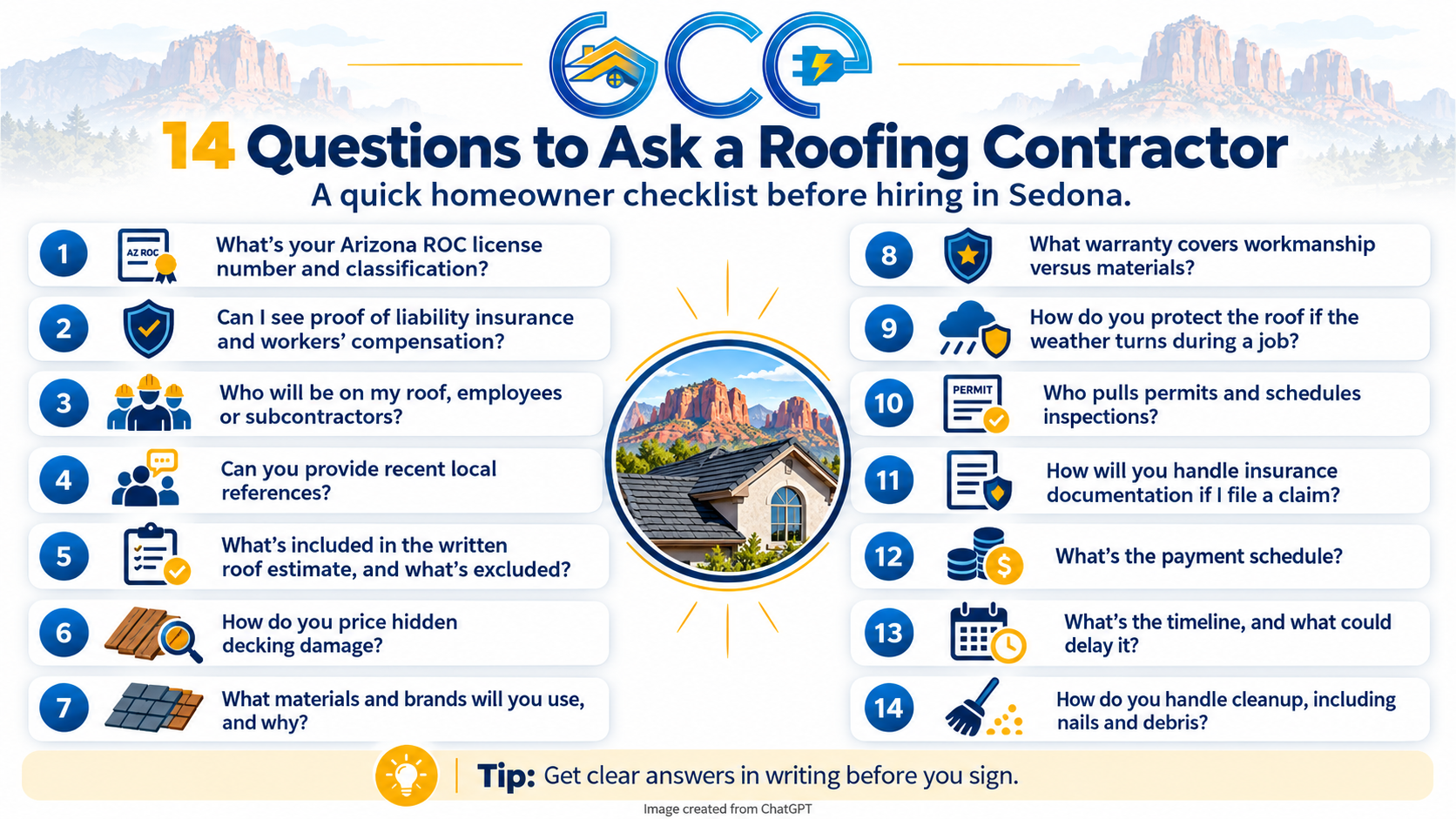
Questions to ask a roofing contractor:
- What’s your Arizona ROC license number and classification?
- Can I see proof of liability insurance and workers’ compensation?
- Who will be on my roof, employees or subcontractors?
- Can you provide recent local references?
- What’s included in the written roof estimate, and what’s excluded?
- How do you price hidden decking damage?
- What materials and brands will you use, and why?
- What warranty covers workmanship versus materials?
- How do you protect the roof if the weather turns during a job?
- Who pulls permits and schedules inspections?
- How will you handle insurance documentation if I file a claim?
- What’s the payment schedule?
- What’s the timeline, and what could delay it?
- How do you handle cleanup, including nails and debris?
| Red Flags | Green Flags |
|---|---|
| Can’t provide a license number | Shares license and insurance proof right away |
| Pressure to sign today | Gives you time to review the contract |
| Large upfront payment | Milestone-based payments |
| Vague, lump-sum estimate | Itemized written estimate |
| No local address or references | Local references and recent nearby work |
| Promises to handle your claim | Provides documentation and lets you manage the claim |
| Door-to-door after a storm | Works from referrals and an established office |
12. Where General Contracting and Electrical Fit In
A roof project often touches other parts of the house, such as electrical, framing, drywall, and exterior finishes. A contractor who handles general contracting and electrical can coordinate the whole job instead of leaving gaps between trades.
Examples:
- Water damage inside the home: Leaks can damage ceilings, insulation, and wiring. If there’s wet insulation near electrical components, have an electrician evaluate before power is restored to affected circuits.
- Rooftop and attic electrical: Attic fans, vent fans, and exterior lighting may need to be disconnected and reconnected during re-roofing.
- Remodels and additions: New roof lines and tie-ins should be planned with the rest of the project.
- Single point of accountability for the whole project.
General Contracting and Electrical Services LLC provides roofing services, including inspections, repair, replacement, and related exterior work, along with licensed general contracting and electrical services across Sedona and the Verde Valley.
See our licensed general contractor page and our roofing services for the full scope.
Expert Tips
- Get written findings after an inspection: Photos and notes make it easier to compare roofers and file insurance claims.
- Ask about the weak points, not just the surface: Flashing, valleys, penetrations, and the roof edge are where leaks often start.
- Get three itemized estimates, and compare scope line by line.
- Photograph your roof’s condition before and after the job
- Keep spare material from tile or shingle jobs for future repairs.
- Schedule maintenance: A short annual check and post-storm inspection are cheaper than emergency repairs.
Common Mistakes Homeowners Make
- Choosing the lowest bid without comparing scope, materials, and warranty.
- Hiring after a storm in a rush without verifying the license.
- Paying most of the cost upfront.
- Letting a contractor control the insurance claim.
- Ignoring ventilation, flashing, and the roof edge while focusing only on the surface.
- Skipping local references.
- Not asking how hidden damage is priced, which leads to surprise add-ons.
Key Takeaways
- Verify the ROC license, insurance, and local references before requesting estimates.
- Insist on an itemized written roof estimate that includes flashing, vents, tear-off, and hidden-damage pricing.
- Match the roofing material to Sedona’s heat, sun, monsoon rain, and fire risk.
- For emergencies, stop the water, document the damage, and avoid paying everything upfront.
- Keep control of your insurance claim, and be wary of anyone who offers to waive your deductible.
- Ask about scheduling and coordination, especially around monsoon season and other trades.
- Commercial roofs need the right license, system experience, and a maintenance plan.
Frequently Asked Questions
1. What should I look for in a roofing contractor?
Look for an active Arizona ROC license in a roofing classification, liability and workers’ compensation insurance, local references, a detailed written estimate, and clear warranty terms. Also look for contractors who explain the work plainly and give you time to decide.
2. How do I verify a roofing contractor’s license in Arizona?
Search the Arizona Registrar of Contractors website using the license number or business name. Confirm the license is active, the classification covers roofing, and the business name matches your contract.
3. How much does a roof estimate cost?
Many roofers provide estimates at no charge, but policies vary. Ask upfront whether there’s a fee and whether it’s credited toward the job. A good estimate follows an on-site inspection and is itemized in writing.
4. What’s the difference between roof repair and roof replacement?
Repair fixes localized damage on an otherwise sound roof. Replacement makes sense when damage is widespread, the roof is near the end of its life, or repeated repairs haven’t solved the problem. A licensed contractor should explain which applies and why.
5. What is the best roofing material for Sedona?
It depends on your home and budget. Metal and tile handle heat and sun well, quality shingles are a common budget-friendly option, and flat roofing suits low-slope designs. Ask about fire rating and ventilation for any material.
6. What should I do if my roof is leaking right now?
Limit interior damage, photograph everything, and call a licensed roofer for temporary protection such as tarping. Avoid climbing on a wet roof, keep receipts, and don’t pay the full cost upfront.
7. Will my insurance cover roof damage?
It depends on your policy and the cause of damage. Storm damage may be covered, while age-related wear usually isn’t. Read your policy and talk to your insurer. A roofer can document damage, but the claim is yours.
8. Should I let a roofer handle my insurance claim?
Let them provide documentation and estimates, but stay in charge of the claim. Be cautious of any contractor who promises approval, offers to waive your deductible, or asks you to sign over your claim.
9. How do I find a reliable local roofing contractor in Sedona?
Verify the ROC license, check reviews, ask neighbors, and request recent local references. Compare at least three written estimates and be careful with out-of-area crews that appear after storms.
10. How long does a roof replacement take?
Most residential replacements take a few days to a couple of weeks depending on size, material, and weather. Tile and metal often require longer lead times. Ask for a written schedule and how weather delays are handled.
11. Do commercial roofing contractors need a different license?
Commercial and residential work can fall under different license classifications in Arizona. Confirm that your contractor’s license covers the type of work and building you have by checking the ROC website.
12. Can a roofing contractor also handle fascia, soffit, and ventilation work?
Many can, and it’s often smart to include them. Fascia and soffit repair and roof ventilation improvements protect the roof edge and attic airflow. Ask whether these are included in the estimate or priced separately.
Conclusion
A good roof outcome starts before the first shingle or tile comes off. Verify the license, get an itemized roof estimate, match the material to Sedona’s conditions, and choose a roofing contractor who explains the work, documents everything, and doesn’t pressure you. If you’re comparing roofing companies in Sedona and across Northern Arizona, the vetting steps in this guide will tell you more than any advertisement.
Need a roof inspection, repair, or replacement in Sedona or the Verde Valley? General Contracting and Electrical Services LLC provides roofing services backed by licensed general contracting and electrical expertise. Contact us for an inspection and a written estimate, or see our roofing services page.
Recent Comments