
Custom Home Builders in Sedona, AZ Licensed General Contractor

ROC #324490 ROC #324782

25+ Years Experience

Free Estimates

Licensed, Bonded & Insured


5-Star Reviews

Licensed & Insured

Local Arizona Contractor

Residential & Commercial

Home Remodeling
Custom home builders in Sedona, AZ design-coordinate, permit, and construct a one-of-a-kind home on your lot, from site evaluation and plans through framing, finishes, electrical systems, and final inspection. General Contracting and Electrical Services LLC (GC&E Services) is a licensed general contractor and electrical contractor based at 44 Finley Dr in Sedona. We hold Arizona ROC #324490 (KB-2 dual residential and small commercial) and ROC #324782 (CR-11 electrical), and we manage custom homes across Sedona and the Verde Valley.
What Do Custom Home Builders in Sedona Do?
A custom home builder, sometimes called a custom house builder, takes a home from an idea on a specific piece of land to a finished, inspected house. The work covers site evaluation, coordination with your architect or designer, an itemized estimate, permitting, construction, trade coordination, and final walkthrough. In Sedona, the lot, the views, and the city’s design and lighting standards shape the house as much as your floor plan does.
What Is a Custom-Built House?
A custom-built house is designed for one owner and one site rather than selected from a builder’s catalog. Layout, structure, materials, and mechanical and electrical systems are specified to fit how you live and what the land allows. That might mean a home stepped down a slope to protect a view, a casita or guest house, a covered outdoor living area that functions as a room, or a lighting and control plan designed from the first drawing.
How Do Custom, Semi-Custom, and Production Builders Compare?
| Custom builder | Semi-custom | Large production builder | |
|---|---|---|---|
| Design | Unique to you and your lot | Modified standard plans | Fixed plan library |
| Site | Your land, any buildable lot | Often builder-owned lots | Builder-owned lots in a community |
| Changes | Broad, priced through change orders | Limited options | Minimal |
| Best for | Distinctive lots, specific needs | Faster, simpler builds | Standard homes in master-planned areas |
If you are comparing large home builders with a local team, the practical difference is flexibility and direct access to the people managing your project. The trade-off is that a custom build asks more of you in decisions up front.
Why Hire a General Contractor for Building a Custom Home?
A general contractor for building a house is the single licensed party responsible for turning approved plans into a finished home. You may also see this role called a home builder contractor or house builder contractor. The general contractor schedules and supervises the trades, orders and sequences materials, manages inspections, and answers for the quality of the work. For custom house building, one accountable contractor keeps the foundation, framing, roofing, plumbing, electrical, and finish trades from working against each other.
GC&E Services is a general contractor for custom homes and a general construction contractor, holding both a KB-2 general contractor license and a CR-11 electrical license. Custom home electric work is where many custom homes run into trouble, because panel capacity, lighting layout, outdoor circuits, and control systems affect framing, ceilings, and finishes. Having the electrical scope planned by the same company that manages the build helps catch those conflicts on paper rather than after the walls are closed. Learn more about our electrical services in Sedona.
What Does Luxury Custom Home Construction Involve in Sedona?
Luxury home construction is defined by the level of detail and coordination rather than a price label. Expect more custom elements per square foot: structural spans that open up views, large glazing packages, stone and tile work, specialty ceilings, layered lighting, and outdoor kitchens, patios, and fire features. Each of these adds engineering, lead time, and trade coordination.
That is why luxury custom home builders should hold planning meetings with the owner early. Window and door packages, tile and stone selections, and electrical rough-in locations all need to be settled before framing is far along. We coordinate with local trade partners, including plumbing, glazing, tile, and plastering, so your selections are sequenced rather than rushed. See our outdoor living work and flooring services for related scopes.
What Makes Building in Sedona Different?
Building in Sedona is different because the land and the regulations are both distinctive. Several local factors commonly shape a custom home here:
Terrain and drainage: Many lots are sloped or rocky. Excavation, retaining walls, and monsoon runoff control can influence foundation design and budget. A soils or geotechnical evaluation is often worth doing before plans are final.
Dark sky lighting: The City of Sedona is an International Dark Sky Community. Its Land Development Code (Section 5.8) requires fully shielded exterior lighting. According to the City, flood lights and string lights are not permitted, and a residential exterior lighting application is submitted with the building permit. Your electrician needs to design around this.
Exterior appearance standards: The City does not dictate specific building colors, but it regulates the light reflectance value and chroma of exterior colors (LDC Section 5.7.F). Choose paint and stucco finishes with that in mind.
Guest houses: Sedona’s code generally allows one additional habitable guest house on a property alongside the main home, with rules (LDC Section 3.4). Confirm what applies to your lot before designing a casita.
Climate: Northern Arizona sees hot summers, freezing winter nights, and monsoon storms, so insulation, roofing, window specifications, and exterior material durability deserve real attention.
Jurisdiction: Lots inside Sedona city limits are permitted by the City. Lots in unincorporated Yavapai or Coconino County, or in Cottonwood, Camp Verde, and other towns, follow different rules, so we confirm the authority first.

What Affects the Cost of Building a Custom Home in Sedona?
The cost of a custom home depends on size, design complexity, site conditions, materials, finishes, and permit requirements, so we do not quote a price per square foot without seeing the lot and plans. The factors that move the number most are:
- Lot conditions: slope, rock, access, utilities, septic or sewer
- Square footage and structural complexity (long spans, large glazing, multiple levels)
- Finish level: cabinetry, tile, stone, flooring, fixtures
- Electrical scope: service size, lighting design, outdoor circuits, control systems
- Roofing and exterior systems
- Engineering, permit, and inspection requirements
- Change orders made after construction begins
A written, itemized estimate based on your actual plans is the reliable way to understand cost. We offer free project estimates.
How Long Does It Take to Build a Custom Home?
A custom home takes longer than most owners expect, and the total timeline includes design, engineering, permitting, and construction, not just the build. Construction duration depends on size, complexity, weather, material and window lead times, inspection scheduling, and the number of changes made along the way. We provide a project schedule once the scope is defined, rather than a one-size-fits-all number.
The most effective way to protect your schedule is to finish design decisions and order long-lead items (windows, doors, specialty finishes) early, and to limit changes once framing begins.


What Permits Does a Custom Home Need in Sedona?
A new single-family home needs a building permit from the local authority having jurisdiction. In Sedona, city permit fees are based on project valuation and include plan review and inspection. Depending on the lot, you may also need grading, driveway, septic, water or utility approvals. Separate electrical, plumbing, and mechanical work is inspected under the building permit.
The City of Sedona adopted the International Codes and the National Electrical Code in 2019, with local amendments. Confirm the current edition and amendments with the City or your contractor before design is final. We help prepare submittals and coordinate inspections. You can verify any contractor’s license at the Arizona Registrar of Contractors.
Do You Build Tiny Homes or Small Custom Homes?
Small and tiny homes follow the same permit path as larger homes in most cases. For example, Sedona’s adopted residential code states that tiny houses must comply with all other requirements of the adopted International Residential Code. Smaller footprints do not eliminate foundation, electrical, plumbing, and inspection requirements, and per-square-foot cost on a small home is often higher than owners expect.
Our focus is custom residential construction, including homes sized to the lot and the owner. If you are comparing tiny house builders or small homes builders, or considering a small home, a guest house, or a custom-built tiny home, contact us with the lot and concept and we will tell you plainly whether it is a good fit for our team.


Can a Modular or Factory-Built Home Be Built in Sedona?
Factory-built (modular) homes can be installed in Arizona, but they follow a different regulatory path than site-built homes. The Arizona Department of Housing certifies factory-built buildings and manufacturers, and installation is permitted through the Department or the local authority. Site work still matters: the foundation, utility connections, grading, and finish work are on-site responsibilities.
If you have searched “modular house builders near me” or are comparing modular house builders with a traditional custom build, ask for the manufacturer’s Arizona certification and a clear scope of who handles foundation, set, utilities, and finishes. Contact us to discuss the site-built portion of a project.

How Do You Choose a Local Home Builder?
When comparing local home builders, including private home builders, start by verifying the license, confirming insurance, and reviewing comparable completed work. A strong local builder also explains permitting and site conditions without being asked. Check these before you sign:
- License. Look up the contractor’s license class and status at the Arizona ROC. Confirm the license covers residential building.
- Insurance and bonding. Ask for current certificates.
- Comparable work. Ask to see completed homes similar in size and complexity. Our portfolio shows examples of our work.
- Written scope and estimate. Look for itemized allowances, exclusions, and how change orders are handled.
- Communication. Ask who your day-to-day contact is and how often you will get updates.
- Trade relationships. Established local trade partners help with scheduling.
Why Choose GC&E Services?
- Dual licensing. ROC #324490 (KB-2) and ROC #324782 (CR-11), listed with the Arizona Registrar of Contractors. Verify current status on the ROC site.
- Building and electrical under one company, which simplifies coordination for lighting, service capacity, and outdoor power.
- Local base. Our office is at 44 Finley Dr, Sedona, AZ 86336. As a Sedona custom home builder, we plan each project around the city’s design, lighting, and permit standards.
- Defined process. Consultation, site visit, estimate, permits, construction, and final review.
- Related services in-house, including roofing, flooring, kitchen remodeling, and bathroom remodeling. Learn more about us.

Frequently Asked Questions
Custom Home Builder FAQs
What does a custom home builder do?
A custom home builder manages the design coordination, estimate, permitting, construction, and inspections for a home designed specifically for you and your lot. The builder hires and schedules the trades, orders materials, and is accountable for the finished quality.
What is the difference between a custom home builder and a general contractor?
A general contractor is the licensed party that manages construction. A custom home builder is a general contractor who specializes in one-of-a-kind homes. GC&E Services holds a KB-2 residential and small commercial license plus a CR-11 electrical license.
How much does it cost to build a custom home in Sedona?
It depends on lot conditions, size, design complexity, finishes, electrical scope, and permit requirements. We do not quote a per-square-foot figure without reviewing the site and plans. A written, itemized estimate is the reliable way to budget.
How long does it take to build a custom home?
Total time includes design, engineering, permitting, and construction. Construction duration varies with size, complexity, weather, and material lead times. We give a schedule once the scope is defined.
Can I change the design during construction?
Yes, but changes can affect cost and schedule, especially after framing or electrical rough-in. We recommend finalizing selections early and documenting every change in writing.
Do I need an architect before hiring a builder?
Not always, but custom homes typically need stamped plans. Bringing a builder in during design helps keep the plans buildable and aligned with your budget. We can work with your architect or designer.
Does Sedona have special lighting rules for new homes?
Yes. Sedona is an International Dark Sky Community and requires fully shielded exterior lighting under LDC Section 5.8, with a residential exterior lighting application submitted with the building permit. Confirm current requirements with the City.
Do you build tiny homes or modular homes?
Tiny and modular homes still require permits, foundations, and utility work. Contact us with your lot and plans so we can tell you honestly whether the project fits our services.
How do I verify a contractor's license in Arizona?
Search the contractor’s name or license number on the Arizona Registrar of Contractors website and check the classification, status, and any complaint history. Our licenses are ROC #324490 and ROC #324782.
Do you offer free estimates?
Yes, we offer free project estimates. Contact us by phone at (928) 451-6374 or through our contact page to start.
What Our Clients Say
5.0 ★★★★★ based on happy customers


How Does the Custom Home Building Process Work?
The custom home process runs in six stages, with design and permitting often overlapping.

Consultation
We discuss your goals, lot, program, and budget range, and what a realistic path looks like.

Site visit
We walk the property: access, slope, drainage, utilities, views, and orientation. Site conditions drive foundation design and cost.

Estimate
We build a written scope and estimate from your plans or design intent. If you are early in design, we advise on cost-sensitive decisions before plans are final.

Permits
We help prepare and track permit and approval submittals with the jurisdiction that governs your lot.

Construction
Site work, foundation, framing, roofing, mechanical, electrical, plumbing, insulation, drywall, finishes, and inspections at required stages.

Final Review
We complete a punch list, coordinate final inspections, and walk the home with you.
Roofing, ventilation, insulation, and flashing should be decided early because they affect durability, energy performance, and appearance. See our residential roofing services.
Our Trusted Partners
Working with reliable local professionals






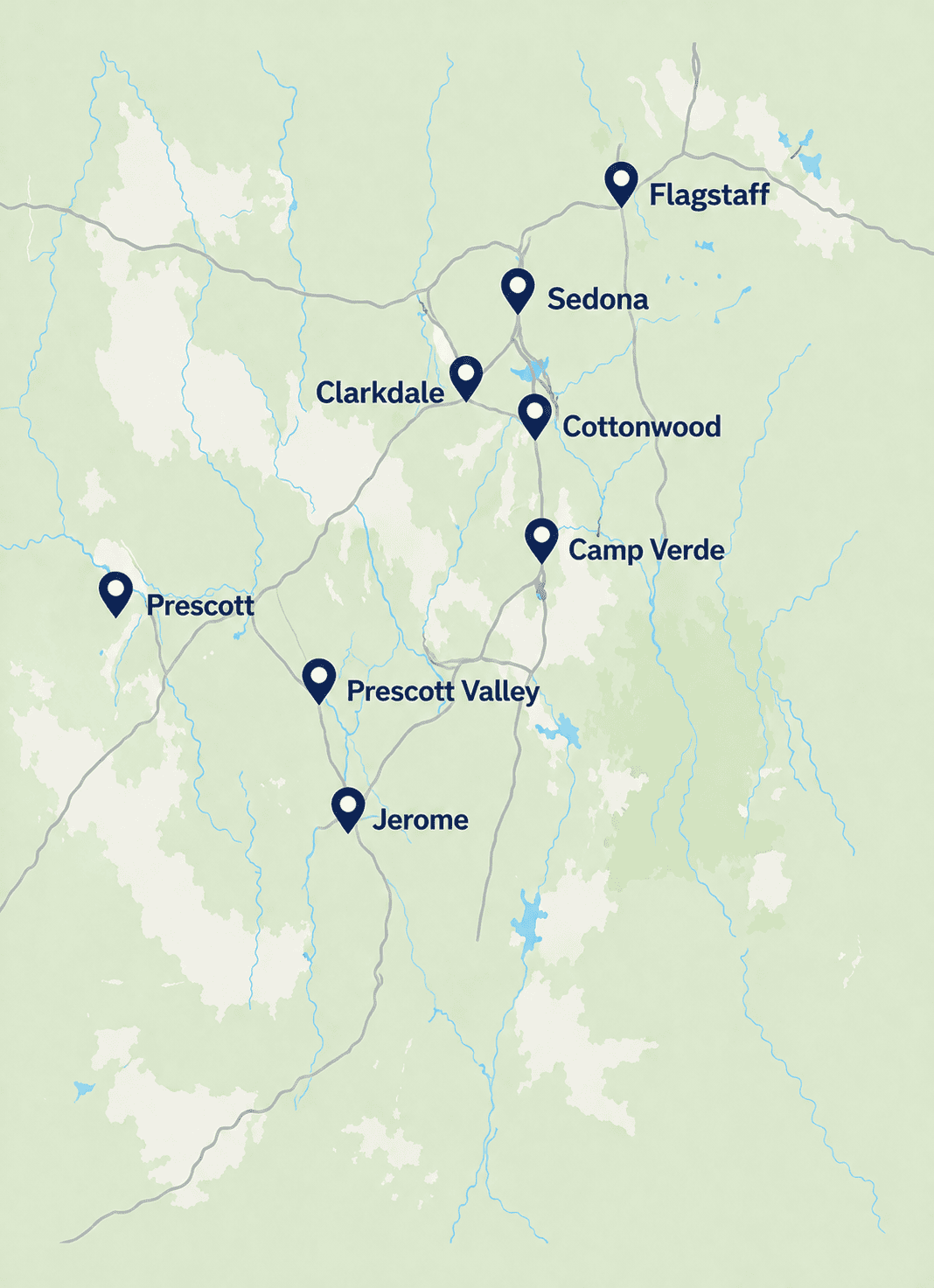
Proudly Serving Northern Arizona.