


Building your dream home sounds simple until you start making the decisions. Custom home building in Sedona means choosing a lot with views and constraints, a design that works within the city’s design standards, a builder and contract you can trust, and a budget that survives a year or more of choices. This guide walks you through the full custom home building process, from first idea to move-in, with the Sedona-specific rules and contract questions most national guides skip.
Quick Answer: What Are the Steps to Building a Custom Home?
Custom home building follows ten steps: set a budget, secure a buildable lot, choose your delivery method and team, finalize design, sign a detailed contract, get permits, build the foundation and frame, install systems, select finishes, and pass inspections. National data shows custom and owner-built homes average longer than production homes, and Sedona’s design rules add planning time before construction begins.
What Makes a Home “Custom”?
A custom home is designed for a specific owner and a specific lot, usually starting from a blank page. That differs from a production home (standard plans in a subdivision) and a semi-custom home (a builder’s plan modified within limits). In Sedona, nearly every lot has its own slope, rock, views and drainage, so even “standard” plans need site-specific engineering.
| Type | Design freedom | Typical trade-off |
| Production | Low | Faster and more predictable; limited choice |
| Semi-custom | Medium | Balance of control and speed |
| Fully custom | High | Most decisions, longest timeline, most budget risk |
What Is the Custom Home Building Process, Step by Step?
This is the sequence most custom projects follow. For the stages shared by every build (framing, rough-ins, inspections) see our Home Construction guide
- Define the vision and budget. List must-haves, nice-to-haves and a firm all-in number covering land, site work, design, permits, utilities, finishes, landscaping and a contingency. Talk to a lender early; construction loans pay out in stages.
- Find and evaluate the lot. In Sedona, check zoning, setbacks, slope, drainage, access, utilities, HOA or plat restrictions, and view corridors before you buy. The right lot can save more than any finish choice.
- Choose your delivery method and team. Decide between design-build and design-bid-build (compared below) and select your architect or designer, engineer and builder.
- Design and pre-construction. Floor plan, elevations, structural and energy details, and early pricing. Good teams price while designing, so the plans don’t outgrow the budget.
- Pricing and contract. Scope, specifications, allowances, schedule and payment terms go into writing (see fixed-price vs cost-plus below).
- Permits. Plans go through city or county review; corrections are normal.
- Site work and foundation. Controlled clearing, grading, excavation and foundation, with inspections.
- Framing and systems. Structure, roof, then electrical, plumbing and HVAC rough-ins, each inspected before walls close.
- Selections and finishes. Insulation, drywall, cabinets, flooring, lighting, fixtures and exterior finishes.
- Final inspections, certificate of occupancy and walkthrough. The building department signs off; you walk the house and agree a punch list and warranty terms.
What Does Sedona Require for a Custom Home?
The City of Sedona’s Community Development Department publishes a Single Family Overview for homeowners and designers. These items shape custom design most (as of the version I reviewed):
| Topic | What the city’s overview says |
| Review path | Administrative single-family residential review; building permit issued when requirements are met |
| Height | Generally 22 feet above natural grade, with some allowances based on design and topography |
| Massing | 2 masses for 1,000–2,000 sq. ft.; 3 masses over 2,000 sq. ft. |
| Exterior color | Generally light reflectance value of 38% or less and chroma of 2 or less; physical samples required with the permit |
| Exterior lighting | Fully shielded fixtures, limited to 4000K; lighting application required with the permit |
| Utilities | All new utilities underground |
| Garage and parking | Garage required over 1,500 sq. ft.; parking by bedroom count |
| Trees | Only trees in the construction area may be removed |
| Guest house | One permitted; max 50% of main house; kitchenette only |
City staff contact: Community Development, 102 Roadrunner Drive, (928) 282-1154. The overview notes staff can only fully review plans once a permit application is submitted, so an experienced team that knows these rules saves redesign. HOA rules are separate and are not reviewed by the city. Neighboring communities (Cottonwood, Camp Verde, Clarkdale, Jerome, Prescott, Flagstaff) and county land have their own requirements.
Lighting and electrical are custom-design decisions here. Shielded, warm-temperature exterior lighting, panel capacity, EV charging, low-voltage cabling and control systems are cheapest to plan before framing. GC&E’s electrical services and control system installation can be discussed during design.
Design-Build or Design-Bid-Build: Which Fits You?
This is the biggest structural choice after the lot.
| Design-build | Design-bid-build | |
| Contracts | One entity designs and builds | Separate architect and builder contracts |
| Accountability | Single point | You coordinate between parties |
| Cost certainty early | Often stronger, since the builder prices while designing | Weaker until bids come in |
| Speed | Often faster (no separate bid phase) | Sequential: design, bid, build |
| Control and competition | Less competitive bidding | More control and comparable bids |
| Risk | Builder influence over design choices | Plans may price above budget |
There is no universal winner. Design-build tends to suit owners who want simplicity; design-bid-build suits owners who want to hand-pick each professional and compare bids.
Fixed-Price or Cost-Plus: How Will You Pay?
| Fixed price | Cost-plus | |
| How it works | Set price for a defined scope | You pay actual costs plus a fee (percentage or fixed) |
| Strength | Budget certainty if scope is complete | Transparency; can be more flexible |
| Risk | Builder adds contingency; changes cost extra | Total cost can drift without a cap |
| Best when | Plans and selections are complete | Scope is still evolving |
A third option is cost-plus with a guaranteed maximum price, which caps your exposure. Whichever model you choose, watch allowances (placeholder budgets for items not yet selected). Vague allowances are where many budget surprises start, so insist on realistic allowance amounts and a clear change-order process.
How Long Does It Take to Build a Custom Home?
NAHB’s analysis of Census data puts the average single-family build at about 8.8 months in 2025 (1.4 months authorization to start plus 7.4 months construction). That average is dominated by production homes. In the 2022 survey, custom and owner-built homes took the longest, averaging 13.4 months. These are national figures; use them for direction only.
Custom builds take longer because design, pricing and selections happen before and during construction. Ask for a milestone schedule, not just an end date, and plan separate time for design and permitting.
How Do You Choose a Custom Home Building Contractor?
- Verify the license at the Arizona Registrar of Contractors (roc.az.gov) and confirm the classification fits the work.
- Ask for insurance certificates and confirm bonding.
- Visit or review completed custom projects, ideally in Sedona or similar terrain.
- Compare itemized proposals, not just totals.
- Ask how they handle allowances, change orders and schedule slips.
- Call references, including a past client whose project hit problems.
- Confirm warranty terms in writing.
Planning to build your dream home? Explore our professional home construction services and choose experienced Custom Home Building Contractors to bring your vision to life with quality craftsmanship and reliable service.
A useful safety net: Arizona’s Residential Contractors’ Recovery Fund, administered by the ROC, reimburses homeowners for poor workmanship or non-performance by a licensed residential contractor; unlicensed work does not qualify.
For a deeper vetting walkthrough, Read How to Choose the Best General Contractor in Sedona and Why Hiring a Custom Home Builder in Sedona Is Worth It.
Custom Home Building Tips
- Design to a number. Ask your team to price at each design stage.
- Finish selections early. Late choices cause delay and change orders.
- Walk the lot at different times of day to understand sun, wind and views before placing the house.
- Plan for monsoon season in your schedule, especially during foundation and roofing.
- Make electrical decisions before framing: outlets, EV, panel size, lighting zones, low-voltage and control wiring.
- Document everything. Keep written approvals for every change.
- Keep a decision calendar with dates by which selections are needed.
- Think about the future: aging in place, guest space, solar-ready wiring.
What Are the Most Common Mistakes?
| Mistake | How to avoid it |
| Buying land before checking buildability | Review zoning, soils, utilities and city rules first |
| Designing beyond the budget | Price during design; set priorities |
| Vague allowances | Use realistic, itemized allowance amounts |
| Hiring on price alone | Compare scope, license and track record |
| Late selections | Use a selection calendar |
| Ignoring HOA or plat rules | Request them before design |
| Skipping contingency | Reserve funds for unknowns |
| Verbal change orders | Require signed written change orders |
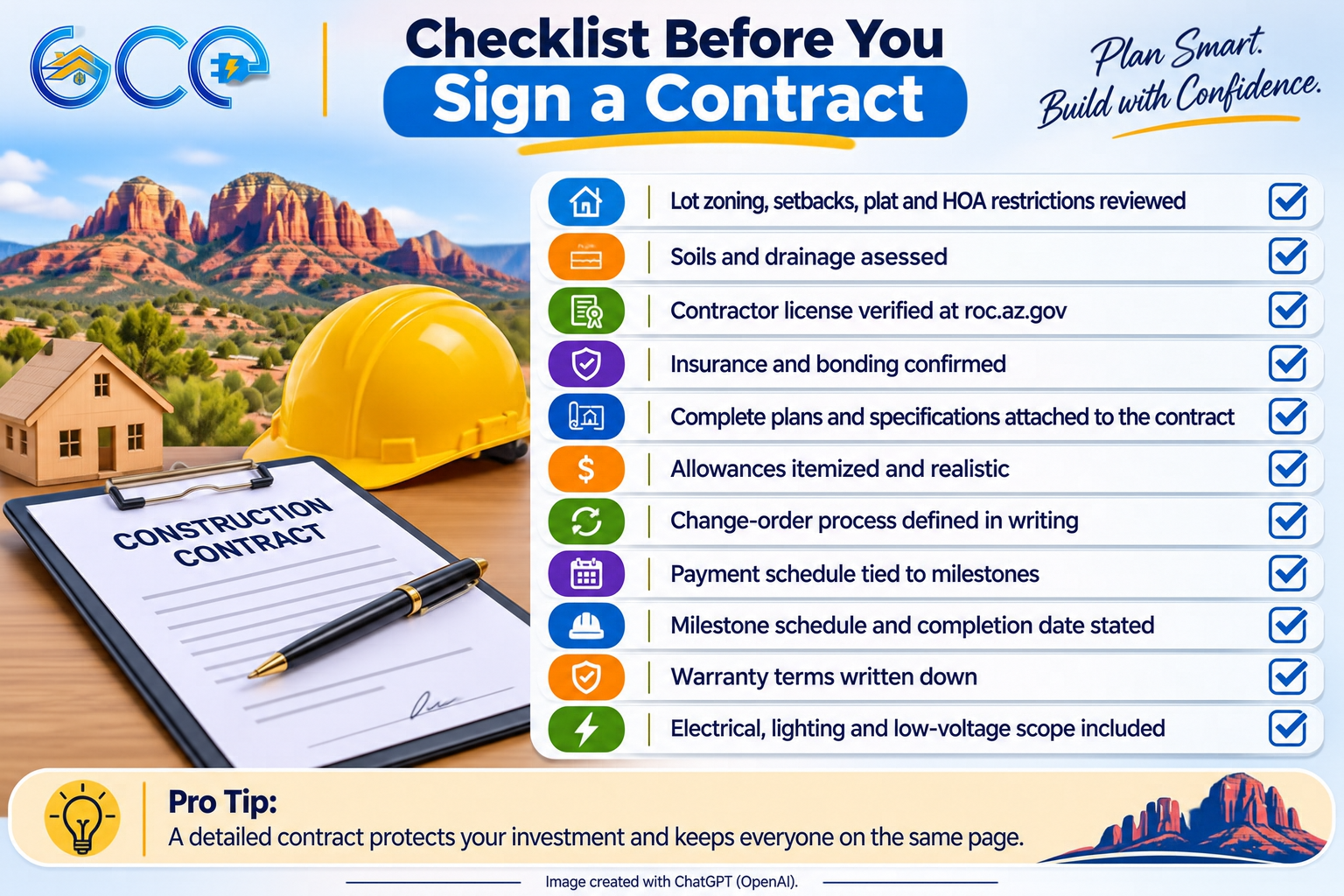
Checklist Before You Sign a Contract
- Lot zoning, setbacks, plat and HOA restrictions reviewed
- Soils and drainage assessed
- Contractor license verified at roc.az.gov
- Insurance and bonding confirmed
- Complete plans and specifications attached to the contract
- Allowances itemized and realistic
- Change-order process defined in writing
- Payment schedule tied to milestones
- Milestone schedule and completion date stated
- Warranty terms written down
- Electrical, lighting and low-voltage scope included
Why Hire a Licensed Contractor for a Custom Home?
A custom home involves dozens of trades, many inspections and thousands of decisions. A licensed general contractor coordinates scheduling, subcontractors, permit submissions and quality checks, and is accountable under Arizona licensing rules. Licensed electrical work matters especially, because wiring mistakes are safety risks and are costly to fix once walls are closed.
General Contracting and Electrical Services LLC, led by owner Peter Sivek, provides residential construction, remodeling and electrical services in Sedona.
Frequently Asked Questions
What is the custom home building process?
It runs from budget and lot selection through design, contract, permits, foundation, framing, systems, finishes and final inspections. The steps are in the guide above.
How much does it cost to build a custom home in Sedona?
It depends on lot, size and finishes, so use a written, itemized estimate. NAHB’s 2024 survey is a national reference only.
How long does it take to build a custom home?
Nationally the average single-family build was about 8.8 months in 2025, but custom and owner-built homes have averaged longer. Sedona permitting adds planning time.
Do I need an architect to build a custom home?
Most custom homes use an architect or qualified designer, either separately or through a design-build firm. Confirm what your builder offers.
Is a fixed-price or cost-plus contract better?
Fixed price suits complete plans; cost-plus suits evolving scope, ideally with a guaranteed maximum. Neither is automatically better.
What permits do I need to build a custom home in Sedona?
A building permit through the City of Sedona’s Community Development Department (or the relevant county), plus related items such as the exterior lighting application.
Can I build a custom home on any lot?
No. Zoning, setbacks, slope, utilities and plat or HOA rules all affect buildability. Check before you buy.
What should I ask a custom home building contractor?
License, insurance, completed local projects, how allowances and change orders work, schedule milestones and warranty terms.
Conclusion
Custom home building rewards preparation. Choose the lot carefully, understand Sedona’s design standards, pick the right delivery method and contract, and plan electrical and systems early. Do that, and the process becomes a series of manageable decisions instead of a series of surprises.
General Contracting and Electrical Services LLC helps homeowners and businesses with residential construction, commercial projects, remodeling, and electrical services in Sedona and surrounding Northern Arizona communities. Contact us to discuss your custom home project or request an estimate, or learn about our new home construction services.
Recent Comments