


A commercial project is rarely just a building. It is a business decision with a budget, a schedule, a tenant or customer base waiting on the other end, and a set of approvals that a homeowner never faces. If you are planning a buildout, renovation or new building in Sedona or elsewhere in Northern Arizona, the choices you make before you hire a commercial construction contractor will shape cost, timing and risk more than anything that happens on site. This guide covers the steps, requirements, design and materials decisions, and the questions to ask before you sign.
Quick Answer: What Should You Know Before a Commercial Construction Project?
Before starting commercial construction, confirm that your site and use are allowed, set a budget that includes design, permits and contingency, assemble a design team, and hire a licensed commercial contractor. Sedona projects may need city development review before a building permit, so approvals can take longer than construction. Early planning of electrical, lighting and low-voltage systems prevents costly changes later.
What Is Commercial Construction, and What Does a General Commercial Contractor Do?
Commercial construction covers buildings used for business: offices, retail, restaurants, lodging, medical and light industrial space, plus the interior work done to adapt them (tenant improvements or buildouts). General commercial contracting means one licensed contractor takes responsibility for coordinating the work: scheduling, subcontractors, permits and inspections, materials, safety and closeout.
It differs from residential work in ways that affect your plan:
| Factor | Residential | Commercial |
| Licensing (Arizona) | Residential classifications | Commercial classifications such as B-1 and B-2 |
| Design | Often owner-driven | Usually requires a design professional; confirm for your project |
| Approvals | Building permit | Often zoning, development review, plan review and fire review |
| Codes | Residential code | Commercial building, fire, accessibility and energy requirements |
| Owner protection | Residential Contractors’ Recovery Fund available | Fund is limited to residential property; contract terms matter more |
| Schedule driver | Owner preference | Business opening date, lease terms, financing |
What Are the Steps in Commercial Construction?
Most commercial projects move through six phases, though names vary by firm.
- Planning and feasibility. Define the use, size, budget and timeline; evaluate sites; review zoning and financing.
- Pre-design and team selection. Hire an architect and engineers, and bring the contractor in early if you can. Early contractor input improves pricing accuracy.
- Design. Schematic design, design development and construction documents, with cost checks at each stage.
- Approvals and pre-construction. Development review (where required), building permit and plan review, bidding or negotiated pricing, contract signing, schedule, insurance and procurement of long-lead items.
- Construction. Site work, structure, envelope, systems, interiors, with inspections at each stage.
- Closeout. Final inspections, certificate of occupancy, punch list, as-built drawings, warranties and training on building systems.
What Are the Commercial Construction Project Requirements in Sedona and Arizona?
Requirements depend on use, size and site. These are the main ones to confirm.
| Requirement | What to know |
| Contractor license | Arizona requires a Registrar of Contractors license for most construction work. General commercial classes are B-1 (any size) and B-2 (small commercial); dual licenses such as KB-1 and KB-2 cover both residential and commercial. Specialty trades hold their own classifications. Verify any contractor at roc.az.gov |
| Zoning and use | Confirm your use is permitted or needs a conditional use permit in your district |
| Development review (Sedona) | Under the city’s Land Development Code, development review is required before a building permit for new buildings. Smaller projects go through minor review; larger ones go to the Planning and Zoning Commission. Projects under 2,000 nonresidential square feet are reviewed as part of the building permit application. |
| Tenant improvements | The city’s tenant improvement packet includes a commercial building permit application, preliminary questionnaire, color and material sample sheet, outdoor lighting application and sign permit application. A plan review deposit is required at application |
| Design professional | The city’s packet notes state regulations on professional design; confirm when an architect or engineer must stamp plans |
| Utilities | City staff reports on past Sedona commercial projects have required connection to the city wastewater system and capacity fees at permit issuance. Confirm for your site |
| Accessibility, fire and energy | Commercial buildings must meet accessibility, fire and life-safety and energy requirements; your design team and the local building and fire officials confirm specifics |
| Insurance and bonding | Contractor liability and workers’ compensation coverage, and builder’s risk insurance for the project |
City contact: Sedona Community Development, 102 Roadrunner Drive, (928) 282-1154. A city planning brochure says applications requiring several reviews can take 4–12 months or more; it is an older document, so treat it as a planning signal. Neighboring communities (Cottonwood, Camp Verde, Clarkdale, Jerome, Prescott, Flagstaff) and county land have their own processes.
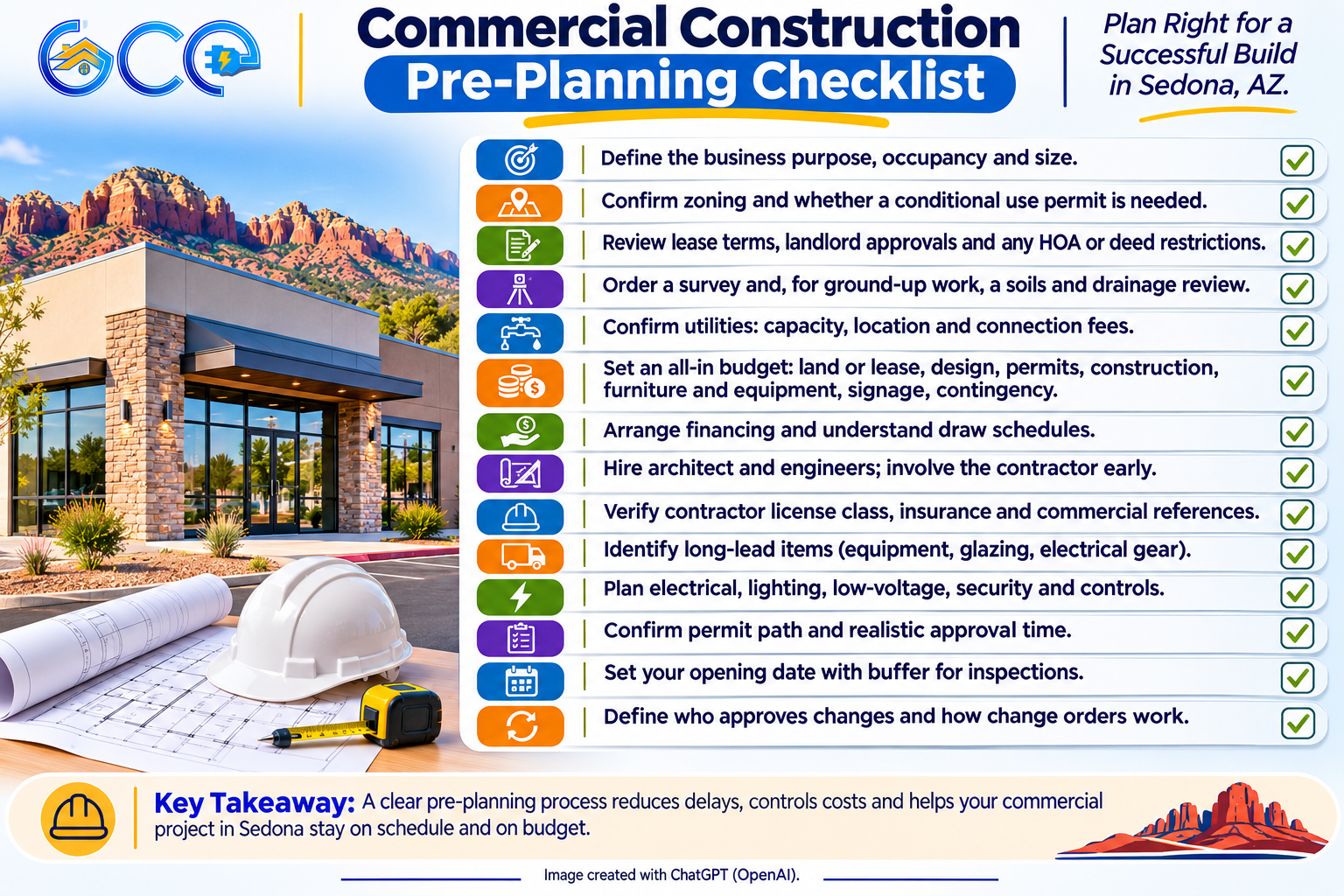
Commercial Construction Pre-Planning Checklist
- Define the business purpose, occupancy and size
- Confirm zoning and whether a conditional use permit is needed
- Review lease terms, landlord approvals and any HOA or deed restrictions
- Order a survey and, for ground-up work, a soils and drainage review
- Confirm utilities: capacity, location and connection fees
- Set an all-in budget: land or lease, design, permits, construction, furniture and equipment, signage, contingency
- Arrange financing and understand draw schedules
- Hire architect and engineers; involve the contractor early
- Verify contractor license class, insurance and commercial references
- Identify long-lead items (equipment, glazing, electrical gear)
- Plan electrical, lighting, low-voltage, security and controls
- Confirm permit path and realistic approval time
- Set your opening date with buffer for inspections
- Define who approves changes and how change orders work
What Are the Key Commercial Building Design Considerations?
| Consideration | Why it matters |
| Use and occupancy | Drives code requirements, egress, fire protection and systems |
| Customer and staff flow | Layout affects sales, safety and efficiency |
| Accessibility | Required for commercial facilities; cheaper to design in than retrofit |
| Electrical and low-voltage | Panel capacity, lighting, data, security and control systems should be designed with the floor plan. See our commercial low-voltage wiring and control system installation pages |
| HVAC and energy | Arizona’s summer heat and cold nights affect equipment sizing, insulation and glazing |
| Parking, access and signage | Site layout and signage need city approval; Sedona’s tenant packet includes a sign permit |
| Lighting and exterior appearance | Sedona’s design review covers colors, materials and outdoor lighting |
| Flexibility | Space that can adapt to a future tenant or use protects resale and lease value |
| Monsoon and drainage | Roof drainage and site grading matter in Northern Arizona storms |
How Do You Choose Commercial Construction Materials?
Material choices balance durability, cost, schedule, appearance and maintenance. The right answer depends on the building type and review standards, so ask your architect and contractor for options with lifecycle costs, not just first costs.
| Material or system | Strengths | Limitations to weigh |
| Structural steel | Long spans, fast erection, flexible layouts | Needs fire protection and corrosion control; lead times vary |
| Concrete masonry (CMU) | Durable, good fire resistance and thermal mass | Slower, labor-intensive |
| Wood framing | Familiar, economical for smaller buildings | Code limits on size and type of occupancy |
| Cast-in-place or tilt-up concrete | Strong and durable | Needs more formwork and curing time |
| Stucco and masonry veneer | Matches Southwestern character; durable if detailed well | Moisture detailing and color approval |
| Metal roofing | Durable and sheds monsoon rain | Choose profile and color to meet design review |
| High-performance glazing | Controls heat gain and glare | Higher cost; long lead time |
In Sedona, confirm colors and materials early: the city’s tenant improvement packet requires a color and material sample sheet, and exterior lighting is reviewed separately.
What Should You Consider Before Building a Commercial Property?
- Can you build what you want, where you want? Zoning and use come before design.
- What does the whole project cost? Include soft costs, utility connections, fees and contingency.
- How long can you wait? Approvals and long-lead items can outlast construction.
- Who bears risk? Understand contract type (fixed price, cost-plus, guaranteed maximum price) and bonding.
- What will you do if the schedule slips? Lease dates and financing terms should allow buffer.
- Will the building adapt? Design for the next tenant, not just this one.
How Do You Choose a Commercial Construction Contractor?
Start with the license, then look at the fit.
| Check | What to ask or verify |
| License class | B-1, B-2 or dual, and whether the class covers your project size [VERIFY cap] |
| Commercial experience | Completed projects of similar size and type, with references you can call |
| Insurance and bonding | Certificates, bonding capacity and who is named as insured |
| Pre-construction services | Budgeting, value engineering, scheduling during design |
| Proposal clarity | Itemized scope, exclusions, allowances, general conditions and fee |
| Subcontractor management | Which trades are self-performed and which are subcontracted to licensed specialists |
| Communication | Meeting cadence, reporting, who is your day-to-day contact |
| Change orders | Written approval before extra work |
For residential-style vetting steps, see How to Choose the Best General Contractor in Sedona. For a deeper look at licensing, see Why You Need a Licensed General Contractor in Flagstaff.
What Affects Commercial Construction Cost and Timeline?
We do not publish commercial cost-per-square-foot figures here because a reliable number requires a defined scope, site and finish level. These are the drivers.
| Driver | Effect |
| Building type and occupancy | Restaurants, medical and hospitality need heavier systems than offices or storage |
| New build vs buildout | Ground-up adds site work, utilities and structure |
| Site conditions | Slope, soils, drainage and access |
| Finish level and signage | Widest range in cost |
| Mechanical, electrical, low-voltage | Capacity and complexity |
| Approvals | Development review and plan-review corrections extend schedule |
| Procurement | Long-lead equipment and glazing |
| Change orders | Late decisions affect both cost and schedule |
What Are the Most Common Commercial Construction Mistakes?
| Mistake | How to avoid it |
| Signing a lease or buying property before checking use and zoning | Confirm approvals before committing |
| Designing before pricing | Check cost at each design stage |
| Underestimating approval time | Ask the city about current review times |
| Treating electrical as an afterthought | Design power, lighting and low-voltage with the layout |
| Choosing on lowest bid alone | Compare scope, license class and experience |
| Verbal changes | Require written change orders |
| Ignoring closeout | Collect as-builts, warranties and manuals |
Why Hire a Licensed Commercial Contractor?
A licensed commercial contractor is accountable under Arizona licensing rules and coordinates design input, permits, trades, inspections and closeout so you can run your business. For owners, one team handling general contracting alongside electrical, low-voltage and control systems can reduce handoffs between trades.
General Contracting and Electrical Services LLC, led by owner Peter Sivek, offers commercial general contracting, small commercial construction, tenant improvements and electrical services in Sedona and nearby Northern Arizona communities.
Read more on our commercial construction contractors.
Frequently Asked Questions
What does a commercial construction contractor do?
A commercial construction contractor manages a business project from pricing and permits through construction and closeout. They coordinate subcontractors, schedules, inspections, safety and budgets under a license for commercial work.
What are the steps in commercial construction?
Planning and feasibility, pre-design, design, approvals and pre-construction, construction, and closeout. Each phase has its own decisions and approvals.
Do I need a permit for a tenant improvement in Sedona?
Yes. The City of Sedona has a Tenant Improvement Building Permit packet covering the commercial building permit application, lighting, materials and sign applications.
What is the difference between B-1 and B-2 licenses in Arizona?
B-1 is General Commercial for commercial projects of any size. B-2 is General Small Commercial with a project-value cap. Confirm the current cap at azroc.gov.
How long does commercial construction take?
It depends on type, size, approvals and procurement. In Sedona, development review can add months before construction begins.
How much does commercial construction cost?
There is no single figure. Use of the building, site conditions, finishes, systems and approvals drive cost, so request an itemized estimate.
Does Arizona’s Recovery Fund protect commercial owners?
The Residential Contractors’ Recovery Fund is limited to residential property, so commercial owners should rely on contract terms, insurance, bonding and lien rights, and consult an attorney.
What should be in a commercial construction contract?
Scope, drawings, price and pricing method, schedule, payment terms, insurance, change-order process, warranty and dispute-resolution terms.
When should I hire the contractor?
Ideally during design, so pricing and constructability input shape the plans.
Conclusion
Successful commercial construction comes from planning: confirm the use and approvals, assemble the right team, design with systems and materials in mind, and hire a licensed contractor whose classification fits your project. The earlier you ask questions, the fewer surprises you face.
General Contracting and Electrical Services LLC helps homeowners and businesses with residential construction, commercial projects, remodeling, and electrical services in Sedona and surrounding Northern Arizona communities. Contact us to discuss your commercial project or request an estimate.
Recent Comments